
July 19, 2026
He Borrowed Someone Else's Swim Trunks Rather Than Call Me
My son packs his own swim bag now. That was the whole idea — he’s twelve, he should be handling it.
Goggles, cap, fins, snorkel, towel, shower gel, dry clothes, trunks. I used to check it every day. Then most days. Now, hardly ever, which I had been feeling rather pleased about.
One afternoon we dropped him at the pool and went to buy something for dinner. Came back, walked in, sat down on the visitors’ benches to watch the last part of training.
His team trains at the far end. From the benches, honestly, they all look identical. We have been meaning to buy him brightly coloured trunks for exactly this reason, so we can pick him out. Never got round to it.
And I’m watching, and I find him, and…
He’s in trunks I have never seen before. Bright ones. Not his.
The part I noticed second
He was quiet that session. That is what struck me afterwards.
Because my son dances. He cannot stand still on the block, he has a whole ritual before he goes in, he waves at us on the way to the changing rooms every single time.
That day he did none of it. He stayed in the water as much as he could. He walked past our bench without turning his head and disappeared very fast.
I understood everything before he came out.
What I asked him
I had a whole speech available. About responsibility, and checking your bag, and what happens when you don’t.
I asked him one thing: did you remember to bring the borrowed trunks home to wash, so we can give them back?
He said yes.
The bit that keeps me up
Here is what I actually think about that afternoon, and it isn’t about him.
He forgot his trunks. Fine. He is twelve, that is what twelve does. He solved it himself — worked out he had a problem, asked another family for help, got in the water, trained. Honestly, resourceful.
But he did not phone us.
He had a phone in his bag and two parents fifteen minutes away and he did not call, because he was afraid of what we would say. He decided it was safer to ask a stranger than to tell his own mother he had made a mistake.
That is not a failure of his. That is mine. Somewhere along the way, in all the reasonable reminders about being responsible, we taught him that coming to us with a problem carries a cost.
I am still working on that one.
Which is why I write about brave people the way I do
Boys are handed a very loud definition of strength. Never back down. Never look unsure. Never admit you don’t know.
Almost none of the people I write about were like that.
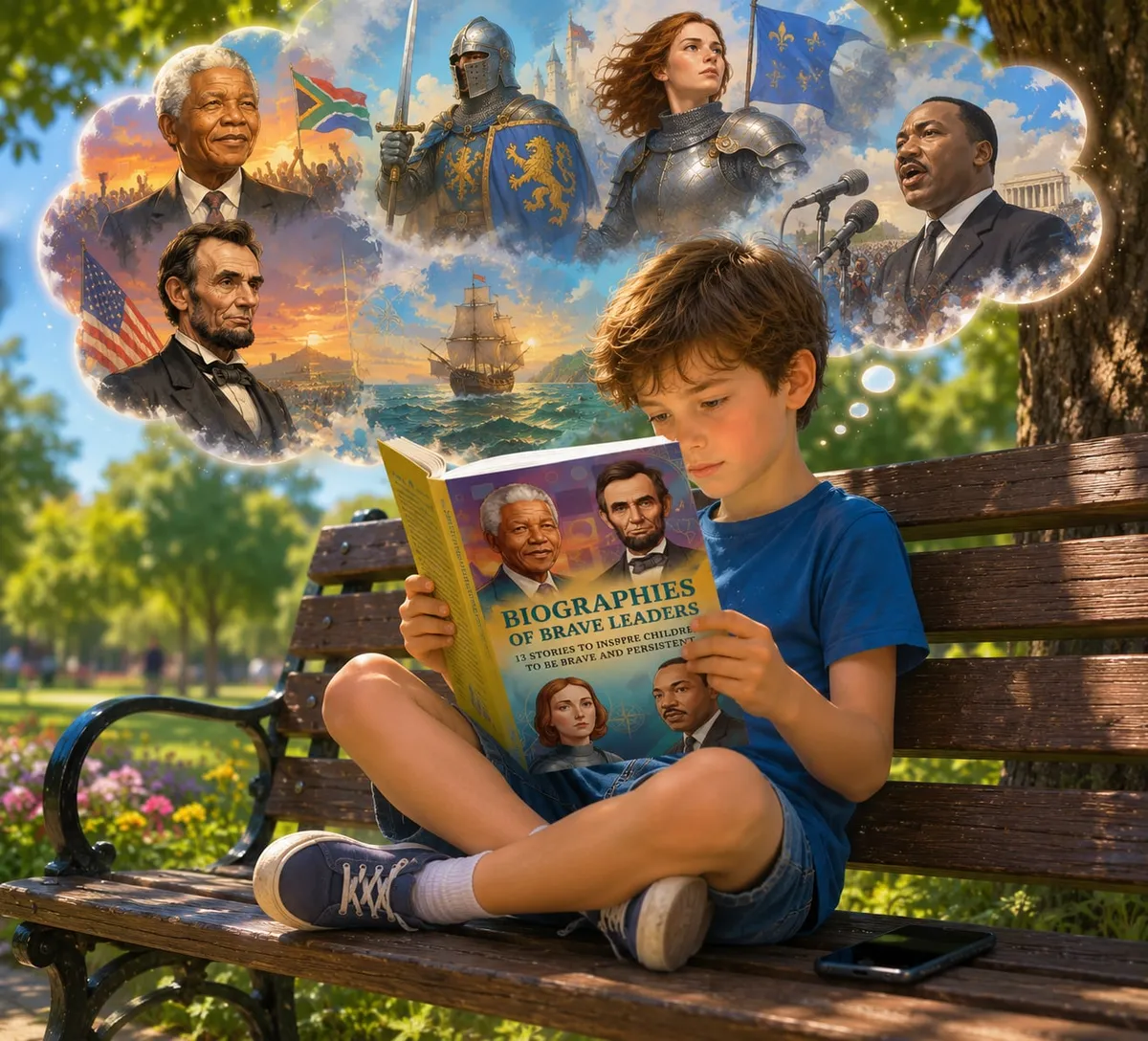
Abraham Lincoln lost election after election, was described by friends as so low at points they took the razors out of his room, and held a country together while half of it despised him.
Nelson Mandela wrote plainly about being frightened in his early years in prison, and came out after twenty-seven of them arguing for forgiveness instead of revenge — which is not the choice that looks strong at first glance.
Martin Luther King Jr. chose words when fists would have been easier and nobody would have blamed him for it.
Joan of Arc was seventeen, from a farm, with no rank and no reason for anyone to listen, and she walked into a royal court anyway.
Four completely different shapes of courage. Not one of them is the shape my son thinks he’s supposed to have.
And every one of them, at some point, needed to say out loud: I have a problem and I can’t fix it by myself.
That’s the sentence I want my son to be able to say to me. We’re getting there. Slowly, and with a lot of me keeping my mouth shut when I want to give the speech.
Lincoln, Mandela, King, Joan of Arc and nine others are in Biographies of Brave Leaders — illustrated stories for ages 8 to 12, with questions at the end of each one. Those questions are the reason I made the book. They’re what gets kids talking, and talking is most of it.