
July 19, 2026
Schools Are Quietly Dropping Handwriting. This Emperor Would Be Furious.
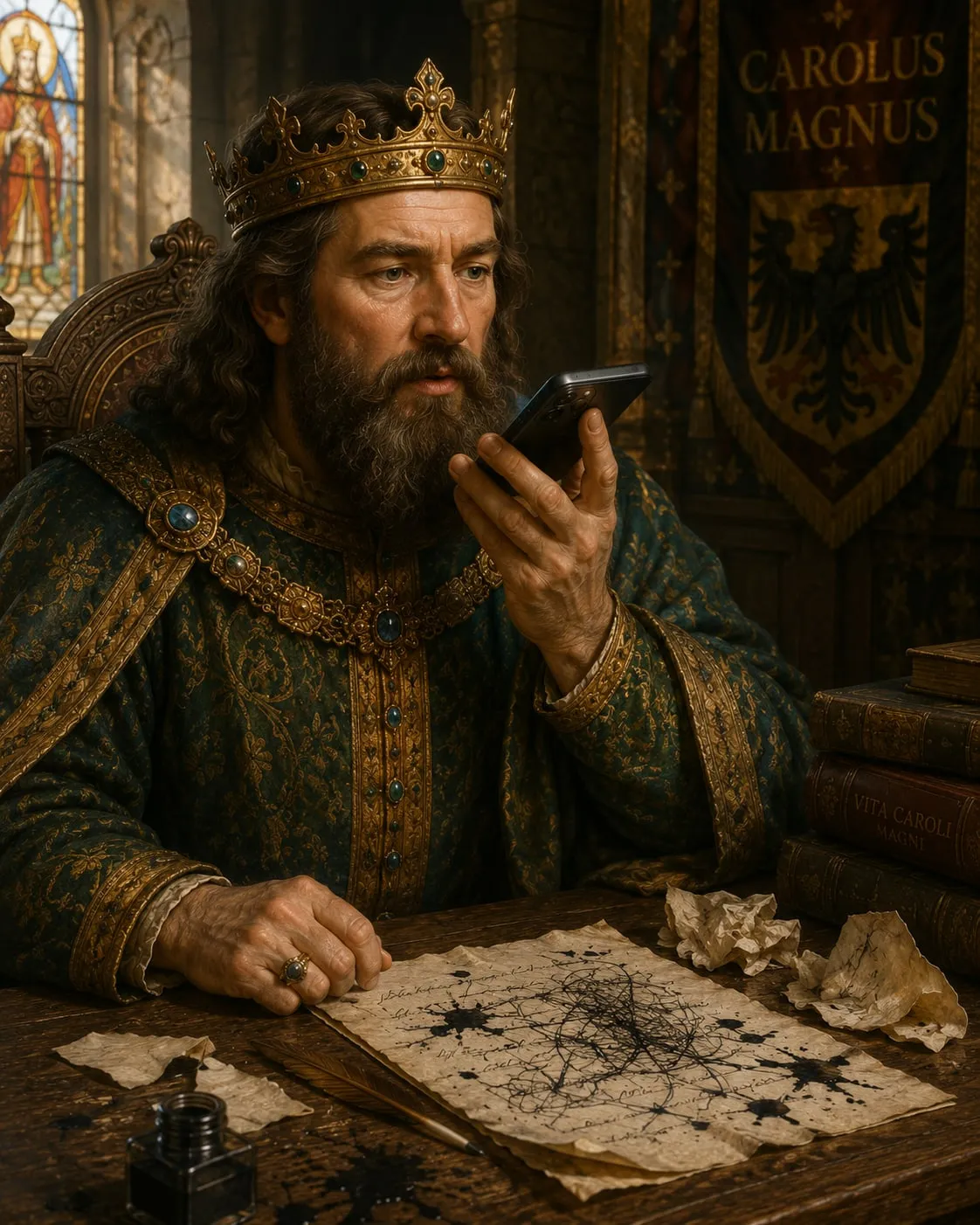
Every year another district quietly drops cursive from the timetable, and every year a few parents notice and most don’t. Mine still writes by hand at school, but the homework arrives as a link, the reading is on a tablet, and I can see where this is going.
I paint. Not professionally, mostly for myself, but enough hours that I know something about what happens when a hand moves slowly and the brain has to keep up. It isn’t nostalgia. Something different goes on in there.
So this next story is one I probably enjoy more than my son does.
A king who couldn’t sign his own name
Charlemagne ruled most of Western Europe. Armies, laws, borders, the lot. Historians call him the Father of Europe and they aren’t being sentimental about it.
He also could not write.
He’d grown up in a century when barely anyone could, and by the time it mattered he was a grown man running an empire, surrounded by scribes who’d happily do it for him. Nobody was going to hand a homework assignment to the most powerful man alive.
Wax tablets under the pillow
His biographer Einhard tells us what he did about it, and the detail is wonderful because it’s so undignified.
He kept wax tablets under his pillow. When he couldn’t sleep, he practised his letters in the dark. A middle-aged emperor, tracing shapes badly, hiding the evidence under the bedding.
Einhard also tells us, with what I imagine was some diplomacy, that Charlemagne started too late in life and never really got good at it.
He kept going anyway.
Why it mattered more than the wars
He didn’t stop at himself. He worked out that a kingdom which can’t read forgets everything it knows, so he brought scholars to his court, built schools attached to monasteries, and ordered old manuscripts copied out before they crumbled.
Historians call it the Carolingian Renaissance. The practical result is this: a large share of the Latin literature we still have survives only because Charlemagne decided writing was worth the trouble.
Not the battles. The copying.
What I take from it as a parent
My son doesn’t have to fight for the chance to write. He has to choose it, over something faster and brighter that’s always within reach. That’s a harder ask than it sounds, and I don’t think we say it out loud to kids often enough: the slow thing is doing something for your brain that the quick thing cannot do.
I’m not romantic about this. Some of it is genuinely just practice and boredom. But there’s decent research on handwriting and memory, and there’s also just watching a child work something out with a pencil instead of a search box.
If you read his story together, a couple of things worth asking:
- He was already the most powerful person in Europe. Why bother learning something he was bad at?
- What’s something you’re not good at yet but want to be?
That second question, in my experience, gets a much longer answer than you expect if you don’t fill the silence.
Charlemagne is one of thirteen people in Biographies of Brave Leaders, illustrated, for ages 8 to 12.