
July 19, 2026
My Son Dances Before Every Race. An Opera Singer Taught Me to Let Him.
My son dances.
Not on a stage. On the wet tiles at the end of a swimming pool, in front of a hundred people, about forty seconds before his race. He has a whole routine. Shoulders first, then arms, then a small shake of the head, like he’s throwing something off.
Every single time.
He is twelve. He trains three hours a day with a serious club, and the other boys on the block stand still, shaking out their hands, staring at the water like they’ve been told to. And there is my sunshine, dancing.
I am going to admit something. For about a year, I quietly wished he would stop.
Not because it embarrassed me exactly. Because I knew how children look at children. I knew somebody would eventually say something, and I wanted to get there first, to protect him from it by smoothing him down.
Then I spent a winter writing about a girl from a village in western Ukraine, and I stopped wishing that.
The girl who would not sing like everyone else
Her name was Solomiya Krushelnytska. She was born in 1872, in a country that did not exist on any map at the time, into a world with very fixed opinions about what a young woman was allowed to become.
Opera then had rules. You hit the notes. You stood where you were told. You sang beautifully and you did not make a scene.
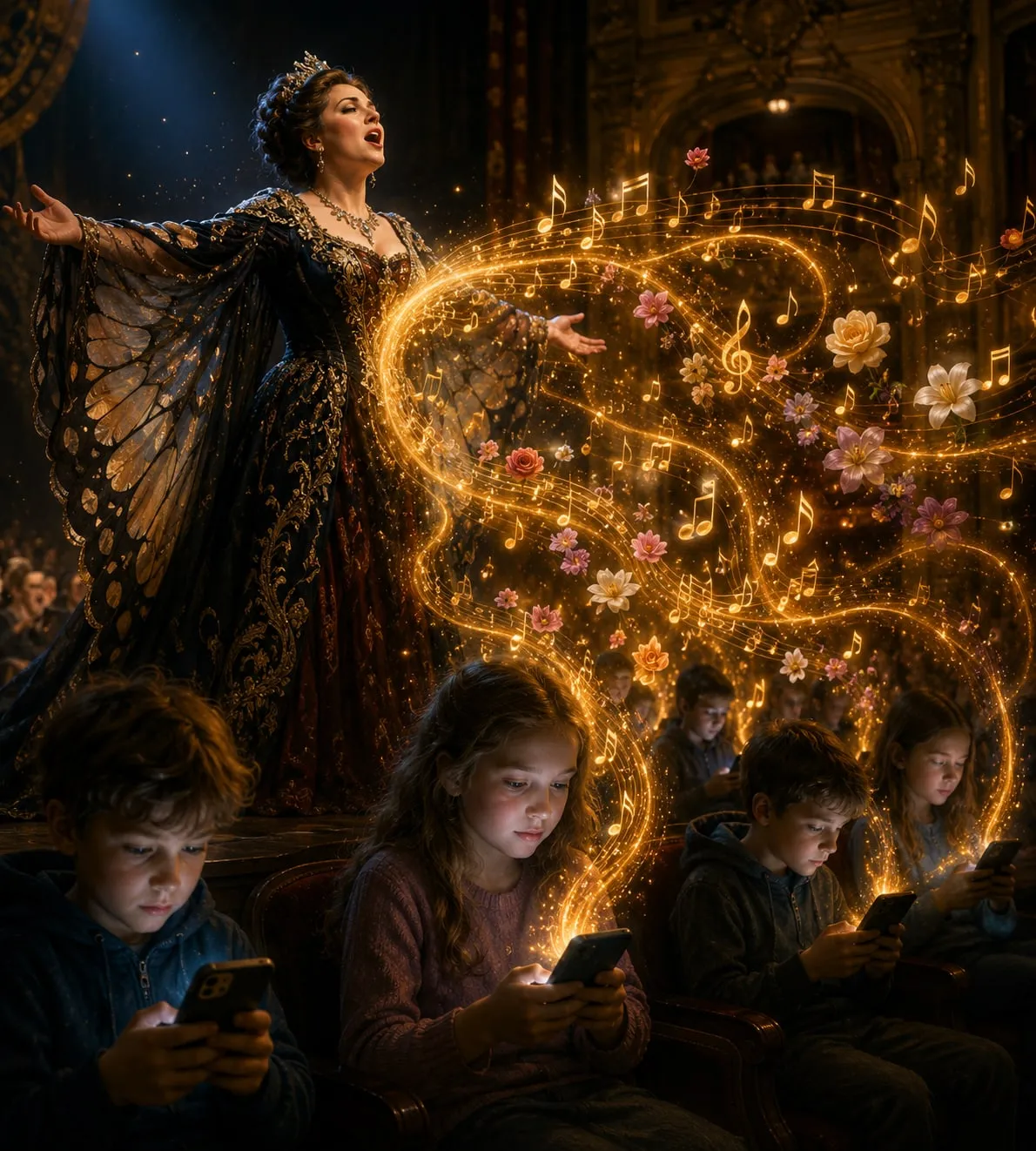
Solomiya sang the notes. And then she acted them — with a physical, emotional force that audiences had genuinely never seen from an opera singer before. People wrote about it as though something slightly alarming had happened.
She did not smooth herself down.
The night she rescued a disaster
In February 1904, Giacomo Puccini premiered a new opera at La Scala. It was called Madama Butterfly, and it failed so badly that he pulled it from the stage after one night. The audience whistled and jeered. He was humiliated.
He rewrote it. And for the second premiere, three months later in Brescia, he asked Solomiya to sing Cio-Cio-San.
That night it worked. The same opera. A different voice inside it.
Madama Butterfly is now performed somewhere in the world nearly every week. Puccini gave her a signed photograph afterwards. He called her the most beautiful and charming Butterfly.
She was thirty-one.
And she never once hid where she was from
Here is the part that stays with me.
She sang in Milan, Paris, Buenos Aires, Cairo, Warsaw. She could very easily have become simply “an international soprano” and left everything else behind. It would have been the sensible career decision.
Instead she finished her concerts with Ukrainian folk songs. In front of audiences who had never heard the language and could not have found the country on a map, she sang the music she grew up with.
She saw no reason at all to make herself smaller.
What I actually think about now
I don’t think my son’s pre-race dance is going to change opera. It is a twelve-year-old boy wiggling on a wet floor.
But it is his. Nobody taught it to him and nobody asked for it, and when he does it, something in him settles. I have watched it work.
And I nearly asked him to stop, so that he would look like the other seven boys on the blocks.
That is the thing I want to say to other parents, and I say it as someone who almost got it wrong: they are surrounded, all day, by filters and edits and algorithms quietly explaining how to look and sound like everyone else. They will get plenty of instruction in blending in. They don’t need it from us as well.
Three questions, if you read Solomiya’s story with your child:
- People said she sang strangely. Do you think that was easy for her?
- Why do you think she kept singing songs from home when nobody there understood them?
- What is something you do that your friends don’t?
That last one is worth waiting through the silence for.
Solomiya’s story, along with fourteen other Ukrainians whose work the whole world knows and whose names it usually doesn’t, is in Great Ukrainians Who Changed the World. Ages 8 to 12, illustrated, written in English.